
Product Design & Prototyping Services for Inventors
You have an idea, maybe a sketch on a napkin or a few photos on your phone. We turn it into a 3D model you can see, a prototype you can hold, and a design a factory can actually build. Our engineers are in Miami and our prototyping lab is in Medellín, Colombia, so you get US engineering with nearshore prices. Everything we create for you belongs to you.
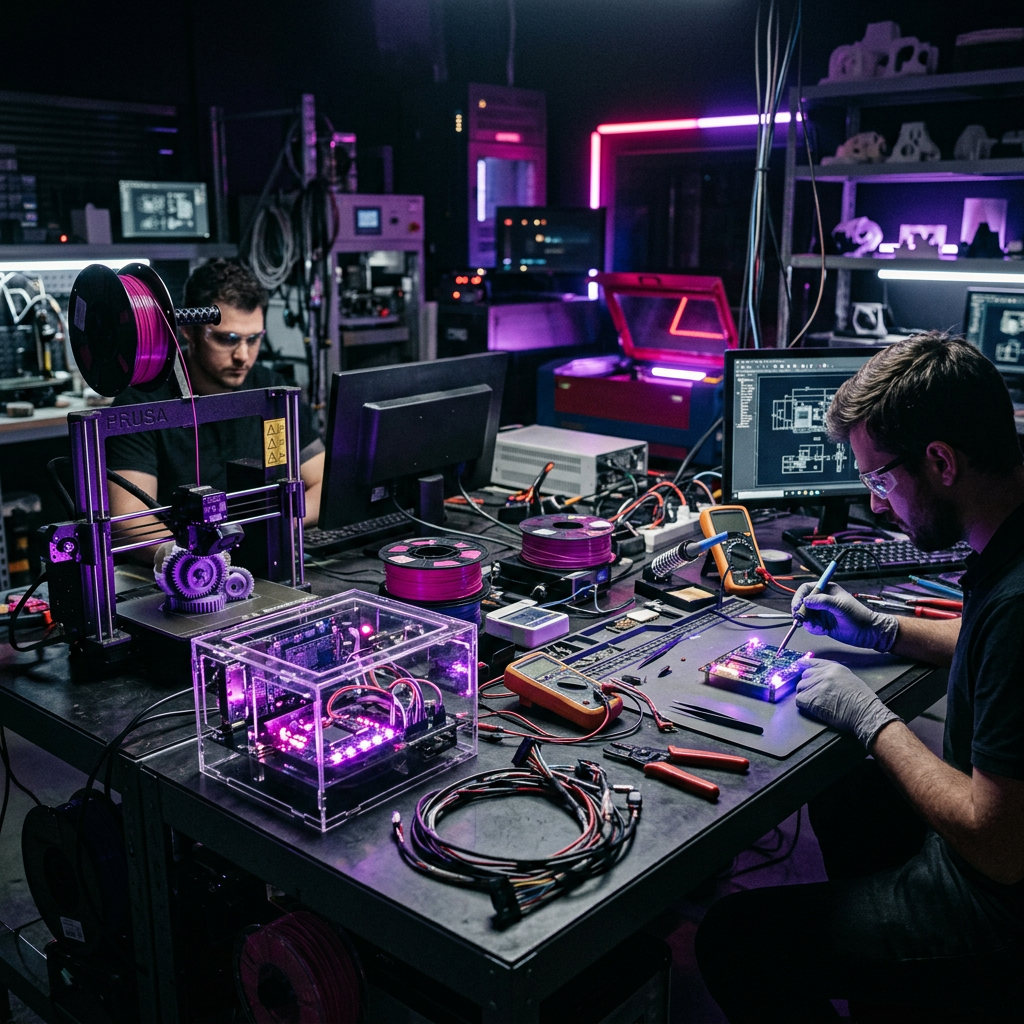
Why prototype before anything else
A prototype answers the questions an idea can't:
- Does it work? Mechanisms that look simple on paper often fail when they meet real materials, real loads and real hands.
- Can it be manufactured at a price people will pay? A design that needs ten machined parts may sell for twice what the market will accept. Catching that early saves you thousands in tooling.
- Will people want it? Investors, retailers and licensing companies respond to something they can hold. A working prototype or a good demo video does more in a pitch than any description.
- What exactly should you protect? Engineering your idea usually changes it. A patent attorney can write stronger claims around the final design than around a first sketch (see our Patent Attorney Referral page).
Our prototyping process
We build in phases. You see results and approve each step before the next one starts, so you never pay for work you didn't agree to.
1. Preliminary Engineering Review
Every project starts here. Our engineers study your idea under NDA and deliver a clear plan for how it can be prototyped and manufactured: feasibility and risks, materials and manufacturing methods, cost estimates, a look at the market, existing patents worth knowing about, and prototyping quotes ready to go. It takes about 3 to 4 weeks and costs $1,295, and the full amount is credited toward your prototyping and engineering phase.
2. 3D CAD design
Our industrial designers and mechanical engineers turn your sketch into precise 3D CAD models built for manufacturing (DFM). We use professional engineering software, including Autodesk Fusion, that lets us simulate how a part behaves under load and heat before anything is printed, so weak points show up on screen instead of in your hands.
3. Form and fit prototypes
Fast, affordable 3D prints test the size, shape, ergonomics and how parts fit together. We print in a range of materials, from standard plastics to carbon fiber composites, plus SLA resin when you need fine detail and smooth surfaces.
4. Functional prototypes
For moving parts, heavy loads or electronics we move to CNC machining, stronger materials and custom PCB (circuit board) design. This is where we prove the mechanism works under real-world stress.
5. Looks-like, works-like prototype
The final prototype looks like a retail product and works like one. It's what you take to investors, trade shows, retail buyers, licensing meetings and photo shoots for pre-sales.
6. Ready for manufacturing
When the design is final we prepare it for production: manufacturing files, bill of materials (BOM) and factory quotes through our network of 315+ manufacturers.
What we prototype
- Consumer products and household inventions
- Baby and kids products (like Pacibaba, the first baby bottle with pacifier storage built in)
- Fitness and sports gear (Trac Rope, the smart jump rope with a touchscreen and heart rate sensor in the handle, The Cricket Stepper, Hinge Tee)
- Wearables and soft goods (like the Grocery Vest, featured on FOX's Snake Oil)
- Personal care and hygiene products (like the BumBum portable bidet, rechargeable with one-button operation)
- Electronics and smart devices with custom circuit boards
- Medical and wellness device concepts (Burn Free)
- Industrial and commercial products (Grease Receiving Holding Systems)
Additive manufacturing has removed most limits on what can be built. As our team explained on Spanish-language TV's El Toro Loco Show (MegaTV), the same technology that 3D prints parts for rockets lets us build anything from a nearly microscopic component to a prototype several feet long. Watch the interview.
How much does a prototype cost?
Costs grow with complexity. These are honest ranges from our own projects:
| Prototype type | Typical range |
|---|---|
| 3D CAD model (virtual) | $400 to $1,700 |
| 3D printed model (non-functional) | $600 to $2,800 |
| Physical working prototype | $2,000 to $22,000+ |
| Fully functional, manufacturing-ready | $4,200 to $25,000+ |
Electronics, machined metal parts and the number of design rounds move a project up the range. You always get a written, phased quote before work begins. For a full breakdown, read How Much Does It Cost to Make a Prototype?. Financing is available through Affirm, subject to credit approval (see financing).
Why inventors choose One Stop Inventing
- You keep 100% ownership of your idea, designs, files and patents. No royalties, no equity.
- Everything is confidential. We work under a mutual NDA from the first conversation about details.
- One team from idea to factory. Research, engineering, prototyping, patent attorney referrals, manufacturing and launch, without hunting for five separate vendors.
- Miami engineering, nearshore lab. Engineering at our Miami headquarters in the University of Miami Life Science & Technology Park, prototyping and small-run manufacturing in Medellín, and large-run manufacturing and sourcing through Hong Kong.
- Track record. 400+ ideas developed for inventors since 2018, and client products that have reached store shelves and TV.
Frequently asked questions
Do I need a patent before you build my prototype?
No. Many inventors build the prototype first under an NDA, then file once the design is final. If you plan to show the idea publicly, talk to a patent attorney about filing a provisional application first. We can refer you to one. Read more.
How long does prototyping take?
The Preliminary Engineering Review takes about 3 to 4 weeks. Prototyping time depends on complexity and the number of design rounds, and your quote includes a timeline for each phase.
Can you add electronics, an app or Bluetooth?
Yes. We design custom circuit boards and work on connected products. Products with electronics cost more and take longer, and your review will spell that out.
Who owns the CAD files?
You do. The files and designs we create for your project are yours.
Can I visit the lab?
In-person meetings are for active clients, once the first phase of work has started. Before that, a phone or video call is the fastest way to discuss your idea.
Do you work with inventors outside Miami?
Yes. Most of our clients are elsewhere in the US and Latin America. We work by phone, video and WhatsApp, in English and Spanish, and ship prototypes to you.
Ready to see your idea for real?
Tell us about it. Your submission is confidential and our engineering team reviews every idea.
También hablamos español.